
Vampyr Lore
All about vampyrs from an author who writes about them
The Appeal of the Vampyr
For centuries, creatures of the night have existed across different cultures and different continents. Each place having their own version of the vampire, but most, all needing blood to sustain themselves. It is of little surprise as a concept, blood is life. You lose enough of it, and you die. The allure of undeath, that immortality could be real, is just entrancing. While many would shun away from immortality at the heavy cost it brings, there are just as many that would welcome it with open arms and a fang-filled embrace. To walk alongside the timelines of reality, to experience history as it occurs without fear, and to stay within the realm that you know instead of the one that you don't, brings about so many emotions and opportunities. It is of little wonder why anyone would want to seek the embrace. What once started in history as a terrifying and grotesque mutation of man, a demon in some religions, has become a sexually thrilling and idolized figure in the supernatural. Books, television, movies, and art have painted the vampire in a much more brash and alluring manner. You see the romance of the bite, the pleasure that it evokes for both the vampire and the donor, and you see the slinky sexy style that modern vampires bring. For those that long for something that will last forever, what is better than a being that will love you till the end of time?
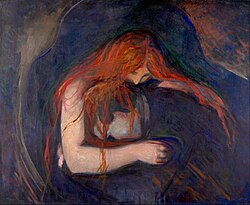
Vampire (1895) by Edvard Munch
Sekhmet
While many look to Eastern Europe at first for vampire lore, you can find it anywhere...include Ancient Egypt! Many have found vampiric inspiration from Sekhmet, the daughter of the Egyptian sun god, Ra. In myth, Ra sent Sekhmet to seek out and destroy any mortals who sought to rise against him. Her bloodlust was eternal and insatiable, draining her way through all of Ra's mortal enemies in battle. When the battle had ended, it was still not enough for her. She continued to tear her way through the throats in Egypt, leaving a bloody massacre in her path until she consumed all of humanity that she could find. Realizing the creature he had created would not stop, Ra and the other gods set forth on a plan to tame her. An entire lake was filled with beer that had been dyed with red ochre to resemble the crimson shine of blood, luring her in successfully as she drank to the depths. Once she had drink all of the beer in the lake and became drunk, she found herself calmed of the bloodlust that had been consuming her. With little rage left to fuel her, she returned to Ra. Or so some myths say...others say she was only further enraged by Ra's deception against her and left Egypt entirely, draining away some of the sun's power. It was up to the god Thoth to convince her to return and restore the sun to it's full power over Egypt. I, personally, much prefer the second ending. Who doesn't enjoy when the woman retains her own self instead of submitting to the ones who would only want to tame her by manipulation?
Wall relief of Sekhmet, Temple of Kom Ombo

Ancient Greece
The Ancient Greek pantheon of gods has no shortage of the powerful and the bizarre, and they are no exception when it comes to those that feast on blood. Empusa, Lamia, and the strix (striges) were all sources of blood feasters in Ancient Greek tales. Empusa was the daughter of the goddess Hecate and was often described as a demonic bronze footed creature. The closest to the modern vampire, she would transform into a beautiful young woman and seduce men while they slept before partaking in their blood. A common interpretation amongst shape shifting vampires that we still see today in some adaptions. Lamia was the beautiful daughter of King Belus while also being one of Zeus's many, many, secret lovers. Secret was the only way you could survive the wrath of Hera, but Hera was cunning and clever and she slaughtered all of Lamia's children when she found out about their affair. Lashing out in a revenge driven madness, Lamia hunted children while they slept and feed on their blood. Her madness and cannibalism is attributed to her later transformation into a terrifying creature physically. Suffice to say, Zeus did what he always did when he had to go back in and try to undo some of the mess he caused and gifted Lamia the gift of prophecy and thee ability to take out and reinsert her eyes...likely because killing her children wasn't enough and Hera also cursed her with insomnia and an inability to close her eyes. The striges also partook in the blood of children, but without the same vengeance as Lamia, they also fed on adults as well, non-discriminating one might say. The striges were generally depicted as having the bodies of crows/various birds and were later subsequently morphed into the strix in terms of their mythology name. A feathery winged creature that would not only drink your blood, but also eat away at your flesh. All in all, I would say Empusa was the one you'd want to run into if you had to pick from the three. Unless you had a very weird reaction to Alfred Hitchhock's The Birds and want to go out that way. To each their own! If you're reading this, you're likely just as fascinated by vampires as me and into all kinds of strange things.
The Kiss of the Enchantress (Isobel Lilian Gloag, c. 1890), inspired by Keats's "Lamia", depicts Lamia as half-serpent, half-woman

Romania
Following up on the tail of the Strix, the Romanian's have the Strigòi. While they share a name with a similar Latine root, the strigoi are vastly different in nature than the Roman striges. Historically, the first mention of note/currently known of a strigoi, was from Jure Grando Alilović who was a village of the region of Istria. He is believed to be the first person of real origin to be described as a vampire. The villagers of Istria reported that Jure was an absolute menace terrorizing his former home region for sixteen years after he has already passed. Imagine having a neighbor you really hate and he comes back and starts stomping your flowers and stealing your blood in your sleep, these people were not having a great time. Eventually, the townsfolk put their foot down and decided graverobbing and desecration of a corpse was the way to go, so they dug poor Jure up and the had the local priest help them decapitate his corpse. They really put the local clergy to work back in those days, nothing compared to the soup kitchen drives that most do now. The lore of the strigoi continued to evolve, in 1865 an article was released on Transylvanian folklore by Wilhelm Schmidt that described the strigoi as nocturnal creates that preyed on infants. Once again, the myth of vampire just really put emphasis on how much they hated children for some reason. This resulted in a tradition where one throws a rock behind them when a child was born and proclaiming "this into the mouth of the strigoi!" because I guess rocks are a great substitute for the flesh of the innocent. Maybe you really can pull blood from a stone? The influence of Jure and those rising from the grave only spread and there were many other instances of villagers being terrorized by the recently deceased and leading to the same pattern of dig corpse up, involve priest, and ceremoniously, take its head off. While the strigoi legends did produce common lore that still exists to this day (no garlic or onions for example) it is worth noting they also were stated to be as bald as Howie Mandel and with long spines with extended tails covered in hair. Perhaps Howie is hiding a tail as well? This is still less of an oddity than the common way of identifying a vampire which was to place a boy of seven years age dressed in white on an all white horse near a graveyard at midday. I am editorializing that they also mention it should be a boy of "purity" because that's a whole other can of weird worms. Either way, the boy and the horse would trapeze their way to the grave of the suspected vampire and you could dig it right on up with the local priest (insert catholic joke) and yet again, behead the beast and drive a stake through its corpsey heart.

India
Now the Vetala are one that I would love to see come up more in modern interpretations, simply because they are such a magnificent blend of the undead and the spirit. Vetala are Hindu mythological beings that are blessed with fortune telling, but come at the cost that they need to inhabit a dead body. The vetala are said to be evil spirits that haunt cemeteries and take over bodily posession of the body they claim. As always in history, they love killing children! They also can drive people to insanity, cause miscarriages, and love to make people miserable in general. But if you get one on the good side, they have been known to guard villages. Maybe just make sure you don't have a lot of children in said village. They are disgruntled for a reason, they are the spirits of the dead trapped in a middle area between life and afterlife, forced to wander graveyards until they find that perfect juicy corpse they like. You can repel then with specific mantras or release them entirely from their trapped void dimension with funerary rites. A much nicer religious intervention than what happens to the strigoi, if you ask me. Their existence between worlds is what allows them that ability to tell fortunes. Tapped into that space they can see the world with the limitless possibilities of no constraint of time. This makes them the perfect prey for the wanton sorcerer who wants to get all the knowledge without putting in any real leg work of their own. If you want to learn more about the vetala, you can seek out the Vetala Panchavimshati which is a collection of twenty-five stories, featuring a vetala as one of the two central characters. I would put this as a remarkably fun read for those who love a more historical setting vampire tale! And you also get the joys of a sorcerer making things worse and see him get punished for it, tsk tsk.
King Vikramaditya and a vetala in the Vetala Panchavimshati.

14th Century
Europe as a whole has a plethora of vampiric lore to get into- but this part will breakdown one of the earliest cases in Europe. There is a Chronicle by Neplach that they estimate as written in 1360. Within his writings, he mentions in 1336 that there was a shepard named Myslata from the area of Blov who had passed away, but apparently did not stay underground. Every evening after his passing, he would walk around town, speaking to everyone as if he was still alive. Rightfully, that's a little spooky and no one really enjoyed that. They enjoyed it even less when he decided to start killing people and putting a death curse on them by hanging around their house and saying their name, which had a Ring type affect where they would die within eight days. As is tradition, and you know well by this point, the villagers dug his corpse up and turned him into a human kabab. As they started in on this entire affair, the body reportedly screamed until someone stabbed him with a stick and blood seeped out of the wound. Fire seemed to stop him, however, all sightings and generally nefarious activities from his spirit stopped immediately afterwards.
That then brings us to the case in 1344 where Neplach writes about a woman from Levin who also rose from her grave shortly after rising, but she was a bit more fun about it. Instead of cursing people, she decided to kill them and simply dance on their bodies. No idea if there were shoes involved in this or not personally, but I can imagine it's quite a mess either way. You know what came next...they dug her up and did the ole stake technique on her as well, staked wound bleeding as it pierced her, much like with Myslata. They did make the mistake of not burning her at first though, she decided for some reason to eat her clothes after the staking and attack several villagers and then finally burned her after getting the bloody clothes out of her mouth. Honestly, I would have left it in. I imagine that's a lot like sticking your hand in a dogs mouth when it has something it shouldn't have, bite beware!

About The Author
First things first, thank you for taking the time to check out my website and read this far to find lil ole me this far down at the bottom! Either you found your way here from my Tik Tok or you just stumbled upon me in the wild. I host another neocities under louisescreatures about my fiction books which largely center around vampires. If you couldn't tell, I've been obsessed with vampires since elementary school when I first picked up an Anne Rice book. A voracious reader, I quickly started making my way through any and all vampire books I could get my hands on. While the website is likely short when you're currently reading this, I will be adding onto it over time while I have free time between work and writing! Have something you'd like to see me feature or talk about on this site when it comes to vampires? Feel free to shoot me an email at louiseoconnorauthor@gmail.com. I apologize in advance if you weren't expecting the more humorous tone many of these descriptions take on, but I think it makes the subject a little less boring when it's historical in tone and just helps keep people reading! Plus, my own books are gothic literature and can get insanely dark and gloomy- need a break sometime for something funny!

Layout made by
Itinerae. Graphics founded from
here.
The font is "UnifrakturMaguntia" from Google fonts.


